



Young entrepreneurs transform Huzhou's villages with innovative operations
In Shuangfeng village, Huzhou, Zhejiang province, a once-abandoned plot of land has been transformed into an idyllic space consisting of rice fields, flowers, and a hip cafe. While in the nearby Ganglang ancient village, an old factory has become a thriving silk cultural and industrial park.
These changes are driven by a new rural development model. A total of 456 villages in Huzhou have adopted a professional, market-oriented management system, led by young entrepreneurs who are reshaping rural development with innovative thinking.
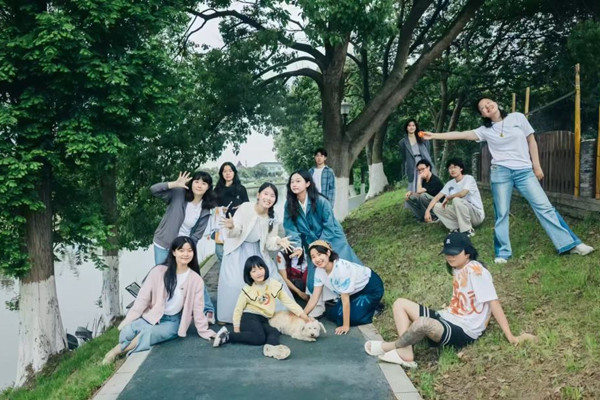
A group of young people takes a photo in a village in Huzhou, with smiles on their faces. [Photo/Huzhou News and Media Center]
In Shuangfeng, young entrepreneur Liu Yi tapped into a yearning to experience pastoral life among urban residents, creating a cafe that offers an escape from the noisy city. The endeavor proved successful. Liu has integrated 133 hectares of farmland to plant unique rice varieties, enhancing both the landscape and economic potential, boosting the village's collective income by 400,000 yuan ($57,296) annually.
Chen Yuanyuan, a young entrepreneur in Ganglang, came up with an innovative development strategy to attract young people by promoting the slow-paced life in the ancient town, capitalizing on the popularity of the nearby Nanxun Ancient Town and the convenient high-speed rail connections. This strategy rejuvenated old properties with creative ventures, making the village a hub for young entrepreneurs.
Huzhou's success hinges on these young visionaries. Their innovative approaches are key to sustainable rural vitalization, supported by the local government's supportive policies and the collaboration with local businesses and villagers.


 play
play